As AI pushes data centers beyond traditional design assumptions, the biggest innovation may not be the racks itself, but how we distribute power.
By Jackson Fahrney, PE – Director of Engineering at PDM

July 31, 2026

If you ask ten people in the data center industry what the biggest AI infrastructure challenge is, nine will likely have an answer centered around power.

Power availability, higher rack densities, and speed to market are all critical parameters to the industry … but from an engineering perspective, I believe we may be asking the wrong questions. 

The question isn’t simply how to generate more power – it’s how we deliver it more efficiently. How do we deliver more compute with the same total load?

Redesigning the electrical architecture to have lower losses (namely fewer transformations and lower ampacities), while future-proofing advancements is a task we can’t ignore.

Consider the scale of what’s ahead: Gartner projects that worldwide data center power demand will grow 27% in 2026 alone, from 104 GW to 132 GW, and to nearly 290 GW by 2030. In the U.S., Goldman Sachs Research expects demand to nearly double, from 31 GW in 2025 to 66 GW in 2027. We cannot simply maintain pace to keep up with that demand; we must get ahead of it. 

The Path Power Takes Today

When most people think about power infrastructure, they may picture just a transformer, but that’s just one piece of a much larger system.

Power typically enters a data center campus at medium voltage (generally 13.8kV – 34.5kV). It passes through transformers, switchgear, UPS systems, and power distribution units before arriving at the rack. 

Along that journey, power is converted several times. Whether voltage magnitude (a step down transformer), rectification (AC → DC), or via an inverter (DC → AC), losses occur at every step. Every additional piece of equipment also consumes space, introduces complexity, and requires maintenance over the life of the facility. 

For years, those tradeoffs made sense, but today’s AI and HPC environments are changing that equation. 

AI is Changing the Design Rules

Traditional enterprise workloads were relatively predictable by comparing historical trends. Around holidays, large events (think Super Bowl or Prime Day), the ramping of equipment could be predicted with high confidence down to the hour. 

AI is different, and workload shifts can cause equipment and operators to see dramatic changes in power, surpassing 20% swings in seconds. This isn’t a hypothetical – Meta’s The Llama 3 Herd of Models paper mentions challenges with power fluctuations, and that is “only” a 24,000 H100 Cluster (30MW of IT capacity).

As rack densities continue to increase, power demands are growing rapidly. Customers want to deploy more compute within the same footprint while maintaining reliability and uptime AFCOM found that average rack density more than doubled from 7 kW in 2021 to 16 kW in 2025 … and at Data Centre World London 2026, consultants said they are already designing racks for U.S. clients expected to draw as much as 2.2 MW per rack within the next five years

From an engineering standpoint, these changes force us to rethink the electrical system – not because the existing architecture is broken, but because it was designed for a different generation of equipment. 

Think in Systems, Not Products

One of the biggest mistakes we make in our industry is evaluating equipment for one component at a time. Power systems don’t operate that way; one equipment selection can have an impact three modules up or downstream.

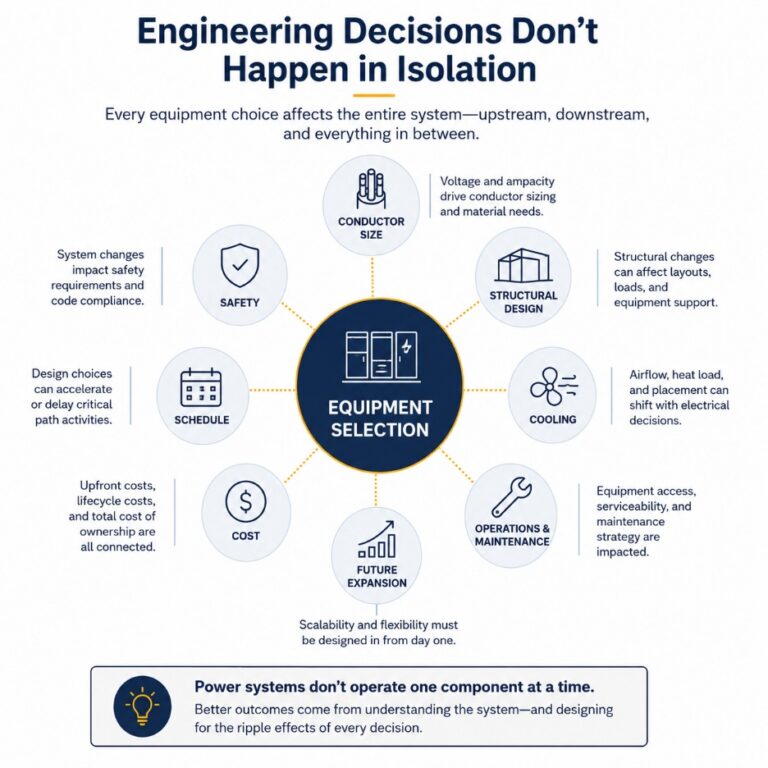
Engineering Decisions Graphic

Changing voltage impacts conductor sizing by changing the ampacity. Conductor sizing affects footprint, underground heat calculations, or structural components. Changing structural components can impact airflow, reroute piping, or displace equipment outside. These all can impact the cost, schedule, and long-term successful safe operation of the data center. 

The real engineering challenge is understanding how these systems work together – and that takes more than technical knowledge. It takes operational know-how: the ability to anticipate how a system will actually run, be maintained, respond when pushed to its limits, and be designed for that range of scenarios from day one. 

That’s why I believe the next generation of AI infrastructure won’t be defined by a single technology. It will be defined by better system design.

Engineering for What’s Next

New technologies will continue to emerge. Some will become mainstream, while others won’t.

Our responsibility as engineers isn’t to chase every new technology. It’s to understand and apply technology to provide the best (re: safe, cost efficient, and functional) solution for a given issue.

Sometimes the best solution is the newest technology. Sometimes it isn’t. The important thing is asking the right questions before making the decision.

Looking Ahead

As power densities continue to increase, we’re going to continue to see new approaches to electrical distribution. These include higher operating voltages, different protection strategies, and more integrated and modular power architectures.

Those changes won’t happen quickly, due to regulatory bodies and industry vetting, but they are coming. The direction is already visible: the Open Compute Project’s Mt. Diablo initiative is standardizing a +400V HVDC hybrid architecture (effectively 800V) industry-wide, and Uptime Institute’s own research points to rack-scale systems of 300 kW and beyond in 2026. On the load-management side, the response to power-swing risk is shaping up to be multi discipline effort. This includes software-level workload shaping, rack-level energy storage, and battery energy storage systems (BESS) at the utility scale. All options are being explored simultaneously, vice individually, further validating a system-based thinking, vice component level. 

Understanding the systems and design intent behind those changes – not just the equipment itself – will help owners, operators, and engineers make better long-term decisions.

Because the future of AI infrastructure isn’t simply about generating more power. It’s about delivering – and using – that power more effectively.

Sources:  
  1. Gartner, “Gartner Says Data Center Electricity Consumption to Grow 26% in 2026,” June 2026. https://www.gartner.com/en/newsroom/press-releases/2026-06-10-gartner-says-data-center-electricity-demand-to-grow-26-percent-in-2026
  2. Goldman Sachs Research, “US Data Center Power Demand Projected to Double by 2027,” May 2026. https://www.goldmansachs.com/insights/articles/us-data-center-power-demand-projected-to-double-by-2027
  3. SemiAnalysis, “AI Training Load Fluctuations at Gigawatt-scale — Risk of Power Grid Blackout?,” October 2025. https://newsletter.semianalysis.com/p/ai-training-load-fluctuations-at-gigawatt-scale-risk-of-power-grid-blackout
  4. Meta’s The Llama 3 Herd of Models paper – 2407.21783v3.pdf 
  5. ComputeForecast, “Data Center Rack Density Standards Are Being Rewritten for AI,” May 2026 (citing AFCOM State of the Data Center reports and Schneider Electric). https://www.computeforecast.com/blogs/data-center-rack-density-standards-rethink-ai-infrastructure/
  6. Uptime Institute Intelligence, “AI to Trigger Radical Overhaul of Data Center Electrification,” December 2024. https://intelligence.uptimeinstitute.com/resource/ai-trigger-radical-overhaul-data-center-electrification 
  7. Open Compute Project, “Realizing the Open Data Center Ecosystem Vision,” October 2025. https://www.opencompute.org/blog/realizing-the-open-data-center-ecosystem-vision  

RELATED RESOURCES

Knowledge is POWER – Explore our other blogs:
Engineering Decisions Graphic
Blog

The Future of AI Infrastructure isn’t just More Power – It’s Smarter Power Distribution

As AI pushes data centers beyond traditional design assumptions, the biggest innovation may not be the racks itself, but how we distribute power. By Jackson ...
Read More →
Blog

The Transformer Isn’t the Problem! 

What Today’s Infrastructure Bottlenecks Reveal About the Future of Power June 24, 2026 By Howard Eaton, PE, Head of Engineering, PDM The greatest challenges in today’s infrastructure ...
Read More →
Infrastructure Supercycle PDM Blog
Blog

We’re in an Infrastructure Supercycle -Hang on Tight! 

May 28, 2026 By Adeel Usman, VP of Sales, PDM The Need for Speed  Over the last several weeks, I had the opportunity to attend ...
Read More →
Case Studies

Custom Dry-Type PDU’s

From VAR Partner to Global Standard for Tech Giant: Repeatable Dry‑Type Platform for high-demand PDUs  As power demands intensify … the real advantage comes from solutions that scale without sacrificing ...
Read More →
Case Studies

Rapid Power Delivery for Hyper-Scale Data Centers

Aggressive Expansion: 1.5 GW in 18 Months  Hyper-scale growth has changed the rules of infrastructure delivery … speed is key.     BACKGROUND:  A management consulting ...
Read More →
Case Studies

Replacing Faulty Transformers

Hyper-Scale Data Center Construction Site, Replacing Faulty Transformers   Hyper‑scale data center builds demand more than fast lead times … they require disciplined execution, clear communication, and partners ...
Read More →