
We’ve heard it time and time again this year: the new currency of data center development isn’t land or connectivity, it’s power. Gartner projects that worldwide data center power demand will grow 27% in 2026 alone, from 104 GW to 132 GW, and to nearly 290 GW by 2030. In the U.S., Goldman Sachs Research expects demand to nearly double, from 31 GW in 2025 to 66 GW in 2027, accounting for the largest percentage of overall global demand.
AI is a major driver of this growth, pushing the industry toward campuses of unprecedented scale and rack densities approaching or exceeding 600 kW. As AI infrastructure continues to scale, the challenge is no longer simply how much power data centers need, but how that power is delivered.
Legacy electrical architectures face increasing pressure around efficiency, footprint, equipment count, and scalability. As a result, the industry is beginning to explore higher-voltage DC architectures that can support greater power density while simplifying the path from the grid to the compute load. As we await the next era of GPUs that will make 800VDC a necessity, the time to start planning to transition to more efficient power architectures is now.
Why 800VDC?
Higher-voltage DC architectures can deliver more power with substantially less current. Because current decreases as voltage increases for a given amount of power, 800VDC can reduce the amount of copper and cable bulk required to move power through a facility.
Fewer conversion stages can also improve efficiency and reduce associated heat and losses. Potential benefits include:
- Lower CapEx and energy costs
- Less copper and cable bulk
- Reduced electrical infrastructure footprint
- Greater power density
- More compute capacity within the same physical footprint
Taking advantage of those benefits requires rethinking how power moves through the data center, from the utility connection all the way to the rack.
How 800VDC Changes Power Architectures
A lot stands to change when 800VDC is adopted. As McKinsey notes, “Some equipment categories—such as low-voltage switchgear rooms, uninterruptible power supply (UPS), floor power distribution units, per-server power supply units, and AC-rated rack power distribution units and busways—could see reduced or reconfigured demand. By contrast, DC-rated busways and DC-native backup power systems could expand or be newly emergent. Likewise, DC-rated breakers, connectors, and insulation systems could become critical gating components.”
In current architectures, multiple transformation and conversion stages create implications for footprint, efficiency, equipment count, deployment, and scalability. An 800VDC architecture changes where and how those conversions occur, creating opportunities to consolidate equipment and shorten the power path.
Traditional Power Architecture
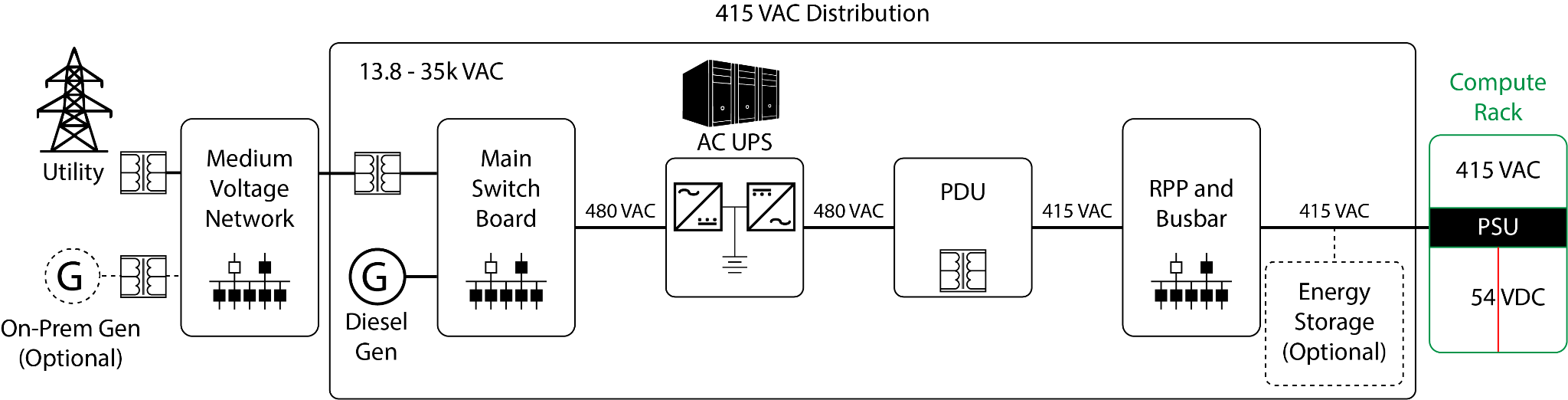
In a traditional power architecture, power from the grid (or on-site power generation system) is sent to a substation. There it’s stepped down to medium voltage AC, and arrives at the data center through trestle systems or underground to main switchgear. There, it is safely routed to internal data center loads. Key components include:
- Switchboards, switchgear, and breakers: Protect and distribute power to downstream equipment.
- Uninterruptible Power Supply (UPS): Conditions power and provides backup during disruptions.
- Power Distribution Units (PDUs): Step voltage down and distribute power to groups of racks.
- Remote Power Panels (RPPs): Extend and manage branch circuits closer to the racks.
Emerging Power Distribution Architectures
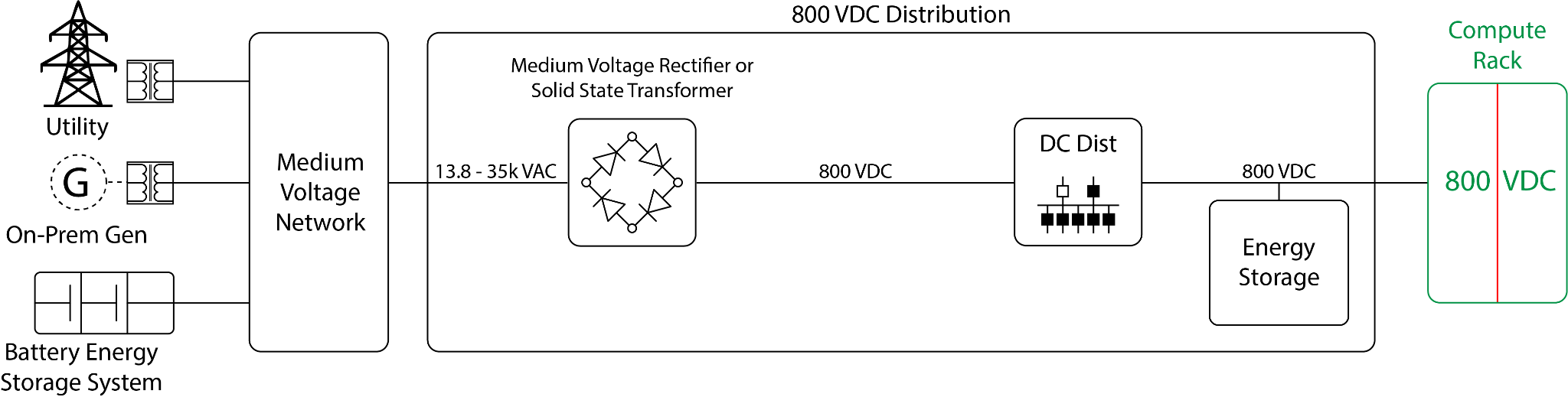
800VDC changes the traditional power path by reducing conversion stages and distributing power at a much higher DC voltage. Instead of stepping power down repeatedly on its way to the rack, emerging architectures can consolidate conversion and deliver 800VDC closer to the compute load to reduce electrical losses, cabling, equipment and footprint while enabling much higher power densities.
Two Paths to 800VDC: Sidecar vs. SSTs
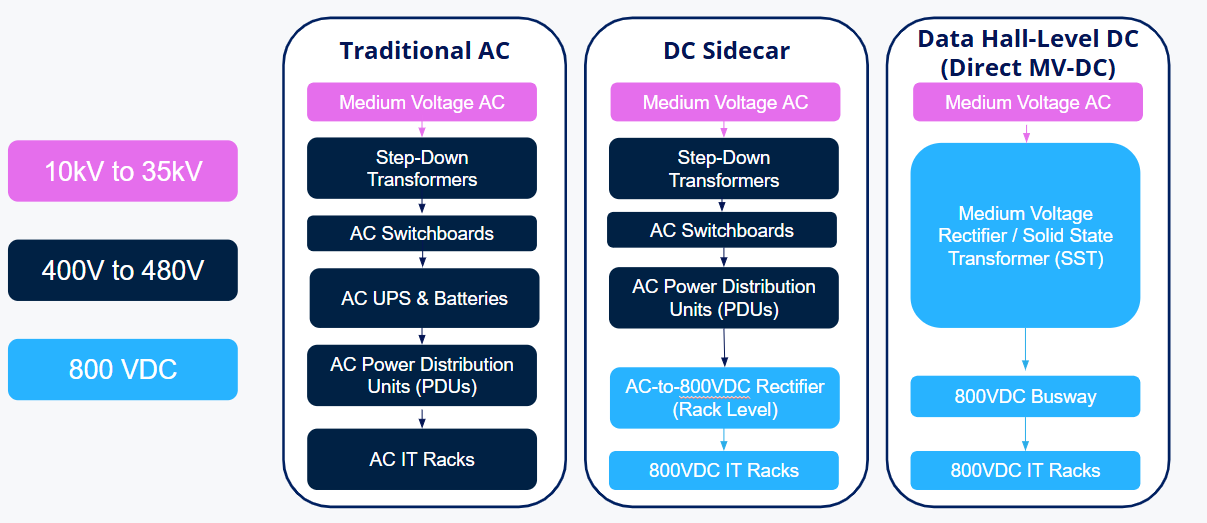
There are two emerging approaches to delivering 800VDC power to high-density racks: 800V sidecars or Solid State Transformers (SSTs). Both can support the transition to higher-voltage DC, but they take different paths through the electrical architecture.
The sidecar approach builds 800VDC onto a traditional AC architecture. Medium-voltage AC is stepped down through transformers and distributed through AC switchboards and power distribution equipment. An AC-to-800VDC rectifier is then added closer to the data hall or racks, converting the AC power to 800VDC for the final distribution to the racks. Sidecars can provide a more practical path for introducing 800VDC into existing facilities, potentially returning rack space to compute and cooling. Rather than requiring an entirely new facility design, this approach can help operators introduce higher-voltage DC distribution while working within the constraints of existing infrastructure.
The SST approach moves the conversion to 800VDC much earlier in the power path, requiring fewer steps. Medium-voltage AC is fed directly into a medium-voltage rectifier or solid-state transformer (SST), which converts it to 800VDC. From there, 800VDC can be distributed through a DC busway directly to the racks. By eliminating multiple downstream AC distribution and conversion stages, this architecture creates a shorter, more direct path from medium-voltage power to the 800VDC rack.
The fundamental difference is where the conversion happens: the sidecar adds 800VDC to an existing AC distribution architecture, while the SST architecture converts power to 800VDC near the front of the power path and distributes DC directly to the load.
A Deep Dive on SSTs: Benefits & Challenges
SSTs can enable medium-voltage AC to 800VDC conversion in a more compact architecture. By using power electronics and semiconductor switches to convert and control electricity, SSTs can consolidate functions that traditionally require multiple pieces of equipment.
Other benefits of 800VDC power architectures incorporating SSTs include:
- High Efficiency: Eliminates power frequency transformers, resulting in zero no-load loss and up to 97.9% component efficiency.
- Energy savings: Soft-switching technology combined with intelligent cooling design significantly reduces operational energy consumption.
- Space efficiency: SSTs are becoming modular building blocks that provide an approximately 60% reduction in footprint, offering strong advantages for data centers and urban infrastructure. Modular components can potentially be replaced without taking the entire system offline, making maintenance faster and less disruptive.
- Cost Efficiency: High system efficiency of 90.8% and no additional power quality equipment (e.g. APF, SVG) required lowers both CAPEX and OPEX.
- Future Readiness: Supports low- and high-voltage ride-through and reactive power compensation, enabling adaptability to complex grid environment
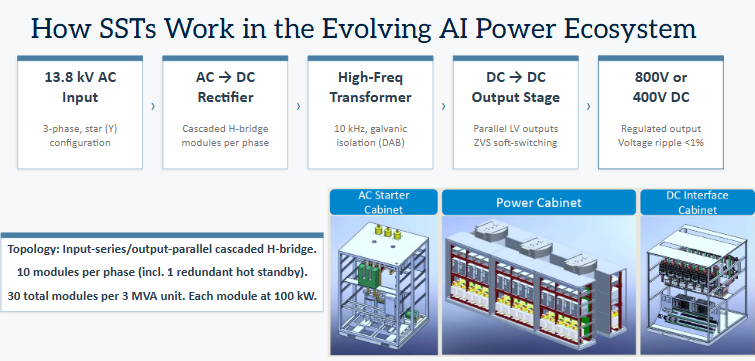
Overall, performance depends on how the technology is executed and integrated, not simply the equipment’s headline specifications. The 97.9% component efficiency figure, for example, does not tell the entire story of system performance; real-world results depend on how the technology is designed, deployed and integrated into the broader power architecture.
What Still Needs to Be Solved
800VDC adoption is advancing, but the ecosystem is still developing. Before the technology can become broadly deployed, data center operators and infrastructure providers need to address several considerations, including:
- Standardization
- Technology maturity
- Reliability and redundancy
- Serviceability
- Availability and supply chain
- Integration with existing infrastructure
- Backup power—and what replaces or reconfigures the traditional UPS model
The technologies that ultimately enable 800VDC will need to work together as an integrated system, with reliability, maintainability and scalability considered alongside efficiency and footprint.
800VDC is an opportunity to rethink the architecture for the AI era. Organizations don’t need to transition overnight, but they should design today with a clear path to 800VDC and the power demands of 2028–2030 and beyond.