
Haitao Liu, Chief Operating Officer, PDM
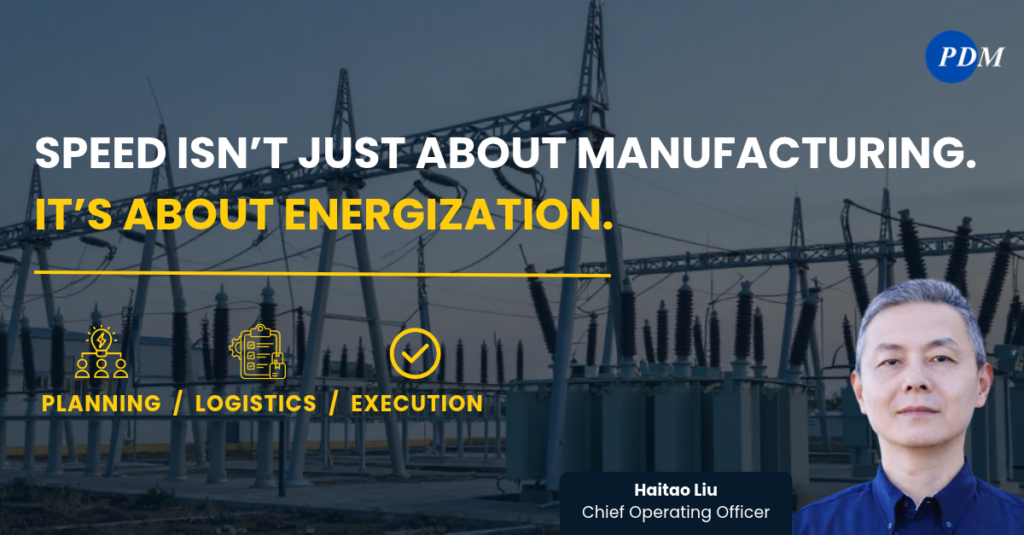
As COO of PDM, my focus is on building an organization that makes it easier for customers to get critical power infrastructure projects delivered faster with greater certainty and consistency.
Transformer manufacturing is central to that mission, but delivering successfully requires much more than manufacturing capacity. It depends on how quickly decisions are made, how effectively engineering and commercial teams work together, how projects are managed, how our manufacturing network is coordinated and how we support customers throughout the equipment journey.
As PDM grows, we have an opportunity to combine two characteristics that customers don’t always experience together: the responsiveness of a lean organization and the engineering discipline and professional execution expected from a major OEM.
That means keeping processes simple, putting responsibility close to the work, and giving customers access to people who can make decisions and follow through.
Simpler Processes. Faster Decisions.
Organizational complexity eventually becomes a cost customers carry.
It can appear as slower responses, repeated conversations, additional approval layers or uncertainty about who owns a decision. As we scale PDM, one of my priorities is to keep that complexity under control.
Customers should be able to work with an accountable team that can bring engineering, commercial, manufacturing and project considerations together quickly.
Consider something as common as a requested change to a transformer design.
Engineering needs to understand the technical implications. Procurement and manufacturing need to evaluate component availability and production impact. Project management needs to understand the potential effects on cost and schedule. And the customer needs clear options to make an informed decision.
A well-designed operating process connects those people early, establishes ownership and gets to a decision.
That’s what less red tape should mean in practice, not fewer controls, but less unnecessary time between the controls that matter.
The objective is simple: make the process as efficient and customer-focused as possible while maintaining engineering and quality discipline.
Professional Project Management Creates Confidence
Responsiveness alone isn’t enough. A responsive organization needs disciplined execution behind it.
For me, professional project management begins with clear ownership of the equipment journey. Technical review, drawing approvals, critical component procurement, manufacturing, testing and logistics all need to connect to a coordinated plan that reflects the customer’s project milestones.
Communication is part of that discipline. Customers should understand where their equipment stands, what decisions are required and whether an emerging issue could affect delivery.
And when something does change, simply reporting the problem isn’t enough.
If a critical component is delayed, for example, the team needs to understand the production impact, evaluate appropriate alternatives and establish a recovery plan, including any customer approvals that may be required.
The same discipline carries through factory testing, logistics, delivery and handoff.
Our goal is to provide the professionalism and execution discipline customers expect from a major supplier while keeping communication direct and decisions accessible.
A Manufacturing Network Built for Flexibility
Manufacturing flexibility is an important part of this operating model. PDM’s strategy combines established global manufacturing relationships, including our joint venture in Asia, with expanding U.S. manufacturing capabilities.
But the advantage isn’t simply having multiple manufacturing locations. The value comes from creating options.
Different projects have different specifications, schedules, sourcing requirements and customer priorities. A flexible manufacturing network gives us additional pathways to evaluate how best to support those requirements.
Making that network effective requires active management. We need visibility into component availability, manufacturing capacity, production constraints, quality requirements and transportation early enough to make commitments customers can plan around.
And regardless of where equipment is manufactured, customers should experience one coordinated PDM team with consistent expectations for engineering, quality, documentation, testing and communication.
As we expand our U.S. manufacturing capabilities, we have another opportunity to increase capacity, strengthen coordination and give customers greater flexibility.
But adding capacity alone isn’t the objective.
The people, processes, supplier relationships, quality systems and operating discipline behind that capacity are what ultimately determine performance.
Speed Is an Outcome of Execution
Lead time matters because of what it enables.
Equipment availability can affect construction sequencing, installation, energization and ultimately when an asset begins generating value.
But speed shouldn’t be treated as an isolated manufacturing metric.
It is the result of decisions made across engineering, sourcing, manufacturing, quality, testing, logistics and project management.
For engineered-to-order equipment moving quickly requires getting important decisions right early and maintaining momentum throughout the process.
That’s why I view accelerated delivery as an outcome of a well-designed operating model.
Our manufacturing leaders are applying that same philosophy at a much more detailed level: engineering readiness, materials planning, production, quality and factory testing all have to work together to create speed without introducing downstream risk.
That is where manufacturing discipline becomes a competitive advantage.
Support Doesn’t End at Delivery
The customer relationship also doesn’t end when equipment leaves the factory. Customers need access to technical support, equipment information and qualified resources as their projects move toward installation and pre-energization.
That requires continuity.
When a customer raises an issue, someone needs to own the response, bring together the appropriate technical resources and keep the customer informed.
It also creates an important feedback loop.
What we learn from equipment, projects and customer experiences should help improve future engineering, documentation, manufacturing processes and project execution.
For PDM, professional aftermarket support is part of building a lasting customer relationship and taking responsibility for the equipment we supply.
Growing Without Adding Friction
As COO, one of the questions I think about is straightforward: How do we become a much larger company without becoming harder to work with?
Growth should give customers more capability, not more complexity. Additional manufacturing capacity should come with stronger processes. A broader portfolio should come with better coordination. More people should create greater expertise without adding unnecessary layers between customers and decisions.
That requires deliberate choices about how teams are organized, where decision authority sits and how accountability is maintained as the company grows.
Our opportunity is to build a company that customers find capable, responsive, and easy to work with.
Simpler processes. Professional project management. Flexible manufacturing. Clear accountability.
Those are the principles guiding the PDM we are building and the standards by which I want our customers to judge our performance.